


Every meeting produces decisions. Yet surprisingly few produce reliable follow-through.
Teams discuss priorities, agree on deadlines, assign responsibility, and then someone has to manually open a project management tool and recreate the conversation as tasks. That extra step is where productivity quietly breaks. People delay updates, forget details, or never log them at all. Over time, execution drifts away from intention.
This gap is exactly why organizations are moving toward action-item tracking without relying on project-management tool workflows. Instead of forcing humans to document conversations, modern systems now convert conversations directly into structured work.
The result is simple: meetings become execution engines, not memory exercises.
The Problem With Manual Task Logging
The traditional workflow looks harmless:
- Hold meeting
- Discuss work
- Someone writes notes
- Later, tasks are entered into the software
But the problem lies in step four: “later” rarely occurs immediately.
By the time tasks are logged:
- Context is lost
- Ownership becomes unclear
- Deadlines become estimates
- Priorities shift unintentionally
This friction compounds across weekly meetings, client calls, internal reviews, and sales conversations. Organizations think they have a planning issue when they actually have a capture issue.
Teams don’t fail at deciding.
They fail at recording decisions fast enough.
The Shift: Capturing Work at the Moment It Happens
Modern teams are eliminating the delay entirely.
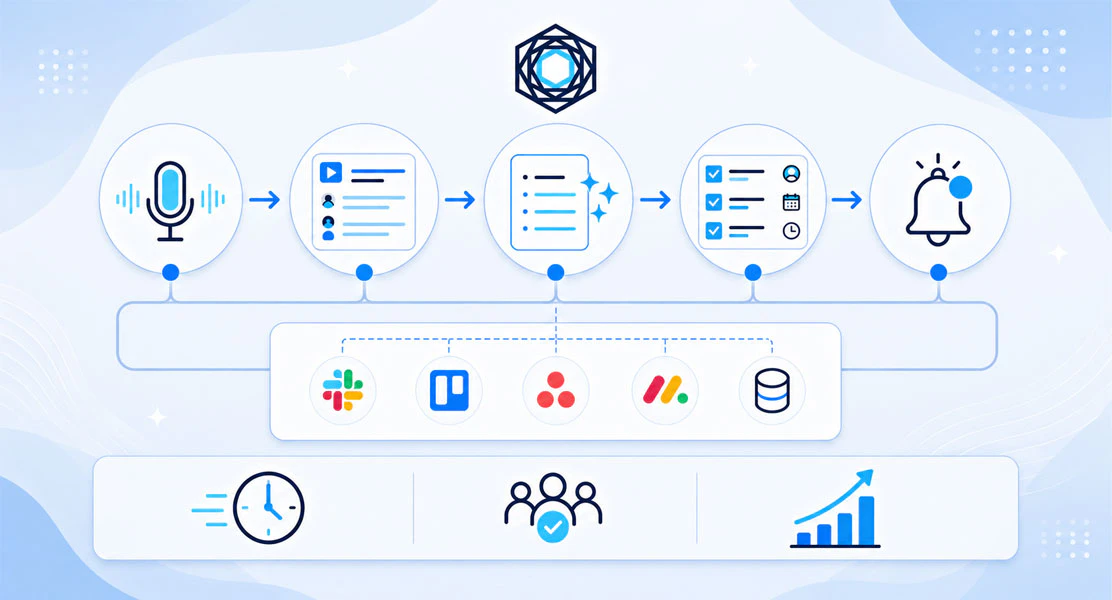
Instead of documenting after meetings, they automatically capture meeting tasks while the conversation is still ongoing. Voice AI listens, understands intent, identifies responsibility, and generates structured action items instantly.
No switching tabs.
No opening dashboards.
No rewriting notes.
This is the core transformation: conversations become workflows in real time.
Platforms focused on voice-first productivity, such as those introduced across the Gennie ecosystem on the main platform, demonstrate how spoken intent can directly drive execution.
How AI Converts Conversations Into Tasks
The process is more sophisticated than transcription.
A recording alone is not a useful interpretation.
Modern systems operate in four stages:
1. Context Recognition
The AI identifies commitments, deadlines, and assignments within speech.
“Rahul will send the pricing by Friday.”
becomes
Assigned task → Rahul → Due Friday
2. Intent Structuring
The system separates discussion from responsibility.
Casual talk disappears.
Commitments remain.
3. Task Mapping
It links the action item to the appropriate workflow, project, CRM, or follow-up.
4. Instant Sync
Tasks appear where teams already work without manual entry.
This process enables teams to automatically convert conversations into tasks, preserving clarity while reducing administrative overhead.
Where This Changes Daily Work
Meetings Become Productive
Instead of ending with “someone write this down,” meetings end with execution already scheduled.
Standups Become Reliable
Teams no longer depend on memory or discipline to update boards.
Sales Calls Become Data Sources
Follow-ups and deal updates are captured within systems such as the voice-enabled Salesforce workflow environment.
Planning Sessions Become Operational
Ideas instantly move into implementation pipelines.
In each case, the bottleneck shifts from documentation to decision-making exactly where it should be.
Real Example: A Typical Team Conversation
A product discussion might sound like this:
“Let’s update onboarding screens, Priya owns it, target next Tuesday.”
“Finance needs the revised forecast tomorrow.”
“I’ll confirm vendor approval today.”
Traditionally, someone writes notes and later opens a tool.
With meeting action items automation, the system produces:
- Update onboarding screens - Priya - Tuesday
- Send revised forecast - Finance - Tomorrow
- Vendor approval confirmation - Today
No second step required.
Why Teams Prefer Voice-Driven Capture
Manual documentation interrupts thinking.
Voice-driven capture preserves momentum.
The benefit isn’t just speed, it’s accuracy.
Humans summarize.
AI records intent.
This difference prevents missed responsibilities and removes ambiguity about ownership. It also explains why distributed teams adopt AI meeting action-item generation workflows faster than traditional documentation methods. Remote environments amplify small inefficiencies; automation eliminates them.
Integrating Action Items With Existing Workflows
Capturing tasks is only useful if they reach execution systems.
Modern voice automation connects captured actions directly into operational tools. For project workflows, structured tasks flow into environments such as the Asana voice-enabled task workspace, where spoken commitments appear as assigned work items instantly.
For customer-facing teams, conversation outcomes sync into CRM pipelines via systems integrated with the Salesforce voice-driven workflow environment, ensuring follow-ups are never dependent on memory.
This integration preserves existing processes while eliminating manual entry, the ideal balance between change and continuity.
Cultural Impact: Accountability Without Effort
When task capture becomes automatic, team behavior changes.
People commit more clearly.
Ownership becomes visible instantly.
Deadlines feel real.
Because everyone trusts the system to record agreements, conversations become sharper and shorter. The organization shifts from a note-taking culture to an execution culture.
Instead of asking “Who was supposed to do that?”
Teams ask, “What’s blocking progress?”
That single change moves companies toward operational maturity.
Who Benefits Most
Leadership
Receives accurate execution visibility without chasing updates.
Product Teams
Ship faster because planning converts directly into tasks.
Sales Teams
Never forget follow-ups after calls.
Operations Teams
Avoid backlog caused by documentation delays.
Remote Organizations
Maintain alignment despite time zone gaps.
Across all roles, the benefit remains consistent less remembering, more doing.
The Future of Work Is Passive Documentation
We are moving toward systems that observe work rather than require reporting about work.
Typing is becoming optional.
Manual logging is becoming a legacy behavior.
The next generation of productivity tools will not ask users to update their status; they will infer status from conversations, decisions, and actions. Organizations that adopt this model early remove administrative friction before it compounds into operational inefficiency.
The goal is not better note-taking.
The goal is to eliminate the need for notes.
Conclusion
The rise of action-item tracking without project-management tool workflows marks a fundamental shift in productivity. Instead of relying on discipline to document decisions, teams now use systems that automatically capture intent.
By enabling organizations to automatically capture meeting tasks, automate action items, and convert conversations into tasks, voice-driven technology turns communication directly into execution.
Meetings stop being preparation for work.
They become work itself.
And when execution begins the moment a decision is spoken, teams move faster, not because they try harder but because friction disappears.