

Administrative work has become one of the biggest productivity drains in modern organizations. Updating tasks, logging activities, scheduling follow-ups, managing CRM entries, and tracking to-do lists consume hours that could otherwise be spent on strategy, creativity, and growth. As businesses scale, these tasks multiply often without adding proportional value. This is precisely where voice AI automation admin tasks emerge as a transformative solution, shifting the burden of repetitive work from people to intelligent systems.
Voice AI is no longer limited to reminders or basic commands. It now functions as an operational layer that understands intent, executes workflows, and integrates directly with business software. By allowing teams to speak instead of type, voice AI reduces friction, eliminates context switching, and restores focus. This shift is redefining how organizations approach productivity, especially in SaaS-driven environments where speed and accuracy are critical.
The Hidden Cost of Manual Administrative Work
Most teams underestimate the time lost to administrative overhead. Simple actions, such as creating tasks, updating statuses, adding notes, or logging interactions, add up quickly. For managers and founders, this often means late updates, incomplete records, and delayed decisions. For frontline teams, it results in interrupted workflows and cognitive fatigue.
Manual admin work also introduces inconsistency. Tasks may be logged differently, CRM entries may lack context, and follow-ups may be missed entirely. Over time, these gaps affect reporting accuracy and operational clarity. Voice AI addresses this problem by creating a seamless way to capture information in real time, directly at the moment it occurs.
By adopting voice-driven automation for business software, organizations reduce dependency on manual inputs and enable systems to keep pace with human activity rather than slowing it down.
How Voice AI Automates Administrative Tasks
At its core, voice AI functions as an intelligent intermediary between people and software. Instead of navigating interfaces, users simply speak. The system interprets intent, identifies the correct action, and executes it across connected tools. This process eliminates multiple steps while preserving accuracy.
A modern AI agent voice assistant SaaS solution can handle a wide range of administrative tasks, including task creation, status updates, meeting notes, reminders, and CRM logging. The assistant does not require rigid commands; it understands natural language and adapts to different speaking styles.
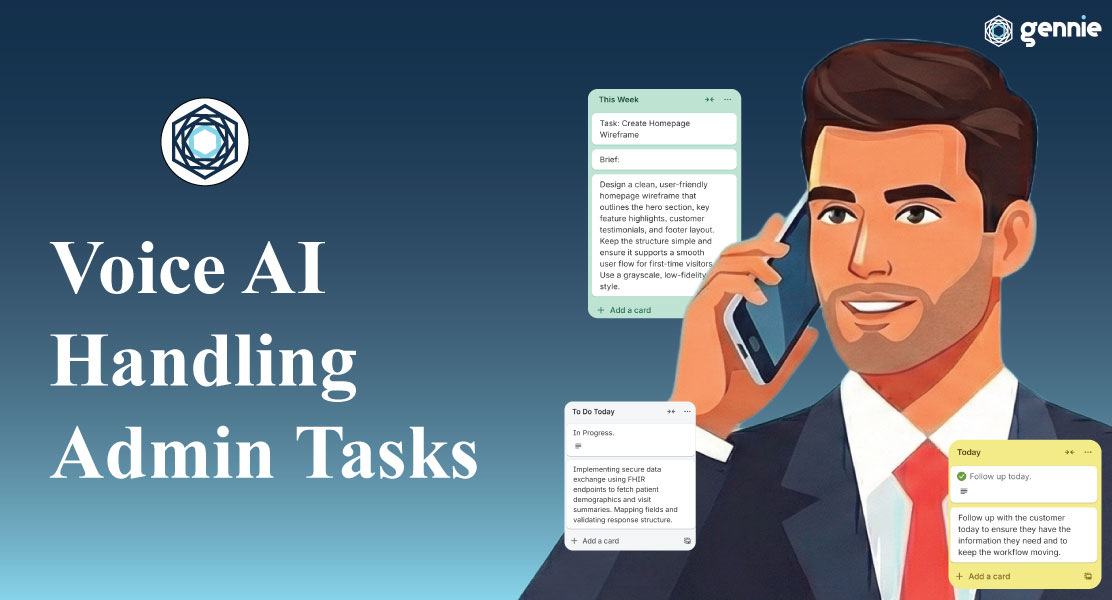
For example, instead of manually opening a task manager, a user can say, “Add a follow-up task for tomorrow and assign it to the sales team.” The voice AI processes the request and completes the action instantly. This ability to translate speech into structured data is what makes voice AI particularly powerful for administrative automation.
Reducing Manual Admin Work Across Core Business Functions
Voice AI’s impact becomes most visible when applied across essential business systems. Administrative work exists everywhere, from project management to sales operations, and voice automation adapts seamlessly to each context.
Task and To-Do Management
To-do lists often fail not because tasks are unclear, but because logging and updating them feels tedious. Voice AI simplifies this process by allowing users to add, complete, or modify functions as they think of them. Teams using voice-enabled task systems experience better task hygiene and fewer missed actions.
For individuals and teams managing daily priorities, voice-based task handling integrates seamlessly with platforms such as the Todoist voice agent, enabling users to maintain structured task lists without interrupting their workflow.
Project Coordination
Project management tools are powerful but often underutilized due to friction with updates. Voice AI removes this barrier by enabling real-time project updates. Managers can update progress, assign responsibilities, or close tasks through simple spoken instructions.
This approach integrates effectively with tools like the Asana voice agent, which translates voice commands directly into project actions. The result is a more accurate and up-to-date project view, driven by real-time input rather than delayed manual updates.
Sales and CRM Administration
Sales teams spend a significant portion of their time on administrative tasks, logging calls, updating deal stages, and adding notes. These tasks are essential for pipeline visibility but often feel secondary to actual selling.
Voice AI changes this dynamic by enabling immediate CRM updates after conversations. Sales representatives can capture details while they are still fresh, improving data quality and reducing end-of-day admin backlogs. Integration with systems such as the Salesforce voice agent enables seamless CRM updates via voice, ensuring consistency without extra effort.
Why Voice AI Is More Than Just Automation
What distinguishes voice AI from traditional automation tools is its human-centric design. Instead of requiring users to adapt to rigid workflows, voice AI adapts to how people naturally communicate. This reduces resistance to adoption and increases long-term usage.
Voice AI also supports contextual understanding. It can associate tasks with projects, recognize priorities, and interpret follow-up intent. This contextual intelligence enables meaningful reductions in manual admin with voice technology, rather than merely shifting functions from one interface to another.
Additionally, voice AI promotes inclusivity. Team members who prefer speaking over typing, or who work in environments where typing is impractical, gain equal access to digital workflows. This makes voice AI a practical solution for diverse, distributed teams.
How Voice-Based Admin Automation Scales With Business Growth
As organizations grow, administrative complexity increases. More tools, more data, and more coordination requirements create friction. Voice AI scales naturally with this growth because it operates at the interaction level rather than the interface level.
A voice-based task automation tool can connect to multiple systems simultaneously, acting as a unified entry point for administrative actions. Whether a company uses one project tool or five, voice AI provides a consistent way to interact with them all. This reduces training overhead and simplifies onboarding for new team members.
Platforms that focus on voice-first productivity, such as those highlighted in the Gennie features ecosystem, demonstrate how voice AI can become a foundational layer rather than an add-on. When voice automation is embedded into daily workflows, it transforms how work is captured, tracked, and executed.
The Strategic Advantage of Voice AI for Founders and Leaders
For founders and leaders, time is the most limited resource. Administrative work often competes directly with strategic thinking. Voice AI offers a way to reclaim that time without sacrificing operational discipline.
By delegating admin tasks to voice AI, leaders maintain visibility while reducing cognitive load. Decisions are informed by up-to-date data, captured effortlessly through voice interactions. This creates a feedback loop where systems reflect reality more accurately, supporting better decision-making.
Voice AI also encourages a culture of immediacy. Tasks are logged when they arise, updates happen when work progresses, and systems remain current. Over time, this discipline compounds into operational excellence.
Conclusion
Administrative work will always be necessary, but it does not have to be manual. Voice AI automation admin tasks represent a shift toward more natural, efficient, and human-centered productivity. By enabling people to speak instead of type, voice AI reduces friction, improves data accuracy, and frees teams to focus on meaningful work.
As voice technology continues to mature, its role in handling administrative tasks will only expand. Businesses that adopt voice-driven automation today position themselves ahead of the curve, operating faster, smarter, and with less overhead. Voice AI is not just an efficiency tool; it is a strategic asset for modern organizations that value time, clarity, and sustainable growth.