

Global teams now operate across countries, time zones, and languages. Work is no longer tied to a single office or a single dominant language.
But most workplace tools still assume everyone communicates the same way. That creates friction:
- Slower collaboration
- Reduced participation
- Communication delays
- Limited productivity
As companies expand internationally, removing language barriers becomes essential.
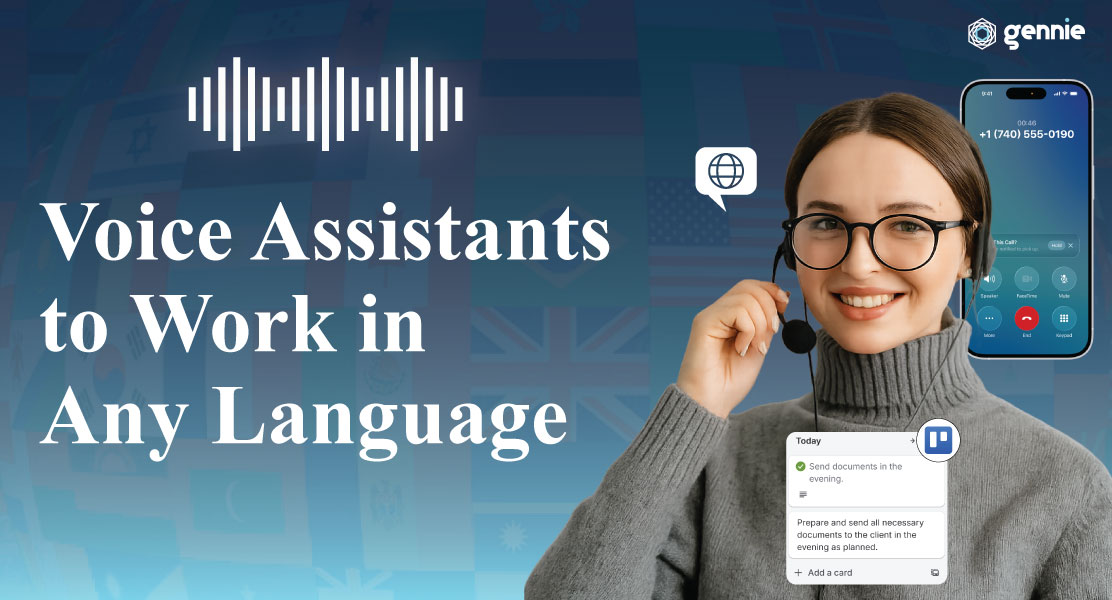
This is where multilingual voice assistant technology is transforming how global teams work.
Voice systems allow people to communicate naturally without translation tools, typing, or switching platforms. When voice supports multiple languages, work becomes accessible to everyone.
This shift reflects Gennie's broader direction, where voice-first technology helps teams work faster across linguistic boundaries.
Why Multilingual Voice Assistants Matter in Enterprise Workflows
Language challenges affect more than communication. They influence decision-making, clarity, and participation.
In global teams spanning multiple continents, even small communication delays can impact operations.
Multilingual voice assistants solve this by enabling:
- Real-time updates in any language
- Unified information flow for leadership
- Faster reporting and coordination
- Equal participation across regions
Employees can:
- Create tasks
- Share feedback
- Report updates
All in the language they are most comfortable with.
Meanwhile, the organization receives structured, standardized output.
This approach aligns with how voice integrations already work in platforms like:
Teams can manage complex boards without changing language or interface. Multilingual voice simply extends this efficiency across global teams.
How Voice Assistants Adapt to Multilingual Work Environments
Modern voice systems do more than translate words. They understand:
- Intent
- Context
- Accents
- Sentence structure
- Cultural communication patterns
They interpret meaning in real time.
For example, a user may speak in:
- Spanish
- Mandarin
- Hindi
- French
- Arabic
The assistant processes meaning, then converts speech into structured workplace actions such as:
- Task creation
- Project updates
- Meeting summaries
The user speaks naturally.
The organization receives standardized output. This creates a powerful operational layer that:
✔ Respects linguistic diversity
✔ Maintains workflow consistency
✔ Ensures accuracy
Real Use Cases for Multilingual Voice Automation
Every global organization faces communication barriers. Multilingual voice automation removes them.
1. Faster Task Logging Across Global Teams
Employees record tasks instantly in their native language. No typing. No translation. Speech becomes structured updates that everyone understands.
2. Real-Time Reporting Without Language Gaps
Standups and shift handovers often require rewriting or translation.
With multilingual voice:
- Team members speak naturally
- Output is standardized automatically
- Everyone stays aligned instantly
3. Inclusive Meetings and Documentation
Participants communicate freely in their preferred language.
Voice tools can automatically:
- Capture decisions
- Generate summaries
- Store structured records
4. Eliminating Delays in Global Operations
Industries like logistics, manufacturing, and customer support rely on fast communication.
Multilingual voice systems:
- Remove translation delays
- Enable instant coordination
- Improve response speed
These examples show that multilingual voice support is not just convenient, it is a core productivity upgrade.
This broader shift is explained further in the Gennie article on how Gennie is redefining productivity, where natural language tools are shaping modern workplace technology.
Why Multilingual Voice Automation Reduces Language Barriers in Business
Traditional digital workflows require uniform input in a single language. That becomes restrictive as teams grow globally.
Multilingual voice automation changes this by:
- Interpreting diverse speech patterns
- Standardizing outputs automatically
- Eliminating translation workload
Instead of people adapting to systems, systems adapt to people.
This leads to:
✔ Higher participation
✔ Better idea sharing
✔ Reduced cognitive load
✔ More inclusive collaboration
Global operations also improve because updates happen quickly without searching for the correct terminology.
Voice tools ensure every voice is heard, literally.
How Multilingual Voice Assistants Integrate With Project Platforms
Voice automation already enables task management through speech. With multilingual support, these benefits expand across regions.
Teams can:
- Update project boards
- Assign tasks
- Modify timelines
- Reorganize workflows
All are using their native language.
This means:
- Projects move faster
- Updates happen instantly
- Teams collaborate confidently
Voice becomes the universal layer connecting global work environments.
Conclusion
As organizations scale globally, seamless multilingual collaboration becomes essential.
Multilingual voice assistants enable teams to:
- Communicate naturally
- Work faster
- Eliminate language barriers
From capturing tasks to coordinating workflows, voice automation is becoming a core part of global operations.
Voice is no longer just an interface. It is a bridge between:
- Cultures
- Teams
- Workplaces
As the global workforce expands, multilingual voice assistants will define the future of productivity.