

Every team takes meeting notes.
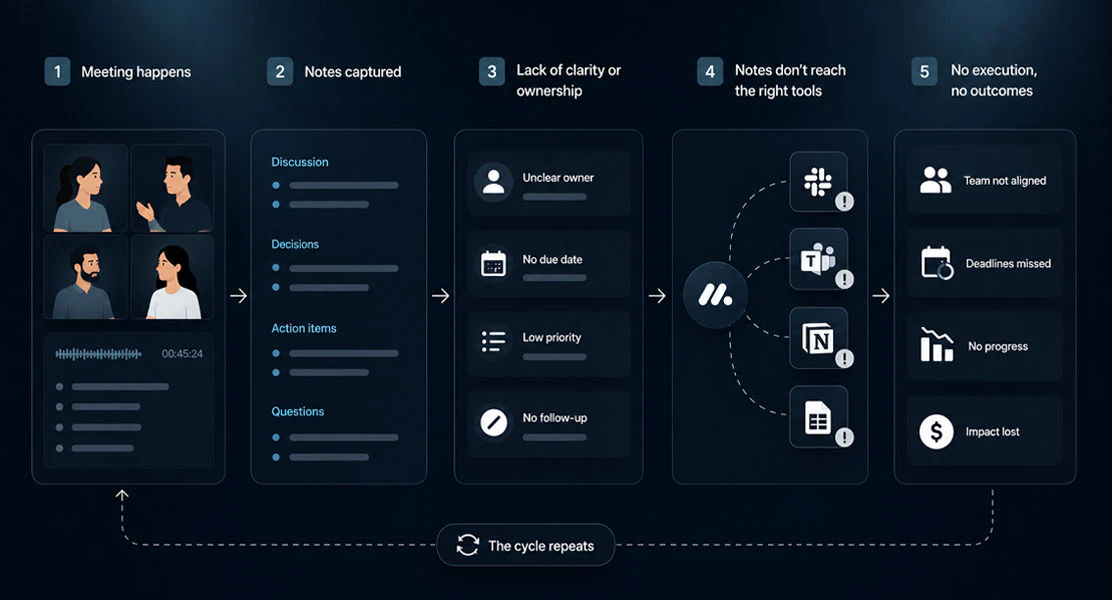
Yet most teams still struggle with missed deadlines, forgotten follow-ups, and action items that quietly disappear after the call ends.
The problem isn't a lack of documentation.
It's a lack of execution.
A meeting can produce dozens of decisions, assignments, and next steps. But if those outcomes never become structured tasks with ownership and accountability, they rarely translate into meaningful progress.
This is why many organizations find themselves discussing the same issues repeatedly despite having pages of meeting notes stored in documents, recordings, and project tools.
The challenge isn't capturing information anymore.
The challenge is turning conversations into action.
The Meeting Productivity Problem Nobody Talks About
Most companies believe better notes lead to better outcomes.
In reality, better notes only create better records.
Meeting notes answer questions like:
- What was discussed?
- What decisions were made?
- What updates were shared?
But they often fail to answer:
- Who owns the next step?
- When is it due?
- How will progress be tracked?
- Where does the work live?
Without those answers, notes become archives instead of execution systems.
This is one reason many teams are now looking for ways to turn meeting notes into actionable tasks automatically rather than simply documenting conversations.
The Five Reasons Meeting Action Items Get Lost
1. Ownership Is Never Clearly Assigned
One of the biggest reasons work stalls after meetings is a lack of clear responsibility.
A task may be discussed extensively, but nobody explicitly owns it.
Team members leave the meeting with different assumptions, and follow-ups never happen.
When ownership is vague, accountability disappears.
2. Action Items Stay Buried in Notes
Most meeting notes contain valuable information.
The problem is that action items are often mixed with:
- Status updates
- Discussion points
- Brainstorming ideas
- Meeting summaries
As time passes, important tasks become harder to find.
Teams rarely revisit old notes when they're trying to execute work.
3. Too Much Manual Follow-Up
Many organizations still rely on someone manually:
- Reviewing notes
- Identifying tasks
- Assigning owners
- Updating project tools
- Sending reminders
This process is slow and inconsistent.
The more meetings a team has, the harder it becomes to maintain.
4. Work Lives Across Too Many Tools
Modern teams use dozens of platforms.
Meeting notes may live in one system while actual work lives somewhere else.
For example:
- Discussions happen on Zoom
- Notes live in documents
- Tasks live in GitHub
- Project planning happens in Notion
- Communication happens in Slack
Without connected workflows, information becomes fragmented.
Many engineering teams solve this by using systems that can automatically turn meeting discussions into GitHub issues, reducing the gap between conversation and execution.
5. No System for Accountability
Even when action items are captured correctly, teams often lack a reliable follow-up process.
Questions start appearing:
- Was the task completed?
- Is someone blocked?
- Has the deadline changed?
- Does leadership have visibility?
Without accountability, meeting outcomes lose momentum quickly.
Why Meeting Summaries Aren't Enough Anymore
For years, productivity tools focused on helping teams capture better meeting summaries.
And while summaries are useful, they only solve part of the problem.
A summary tells you what happened.
Execution determines what happens next.
This distinction is becoming increasingly important as teams look beyond AI meeting summaries to systems that actively support follow-through and accountability.
Documentation without execution creates the illusion of productivity.
Real productivity comes from completed work.
What High-Performing Teams Do Instead
The most effective teams treat meetings as the beginning of a workflow, not the final deliverable.
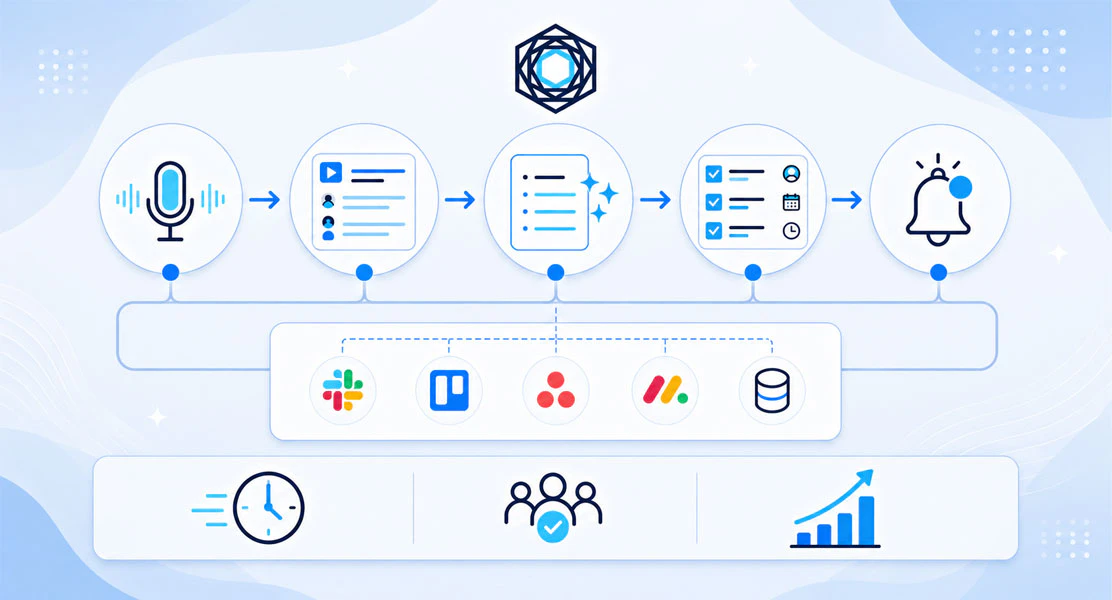
Their process typically looks like this:
Meeting
↓
Action Item Identification
↓
Ownership Assignment
↓
Task Creation
↓
Progress Tracking
↓
Completion
Instead of passively storing information, they immediately connect conversations to execution systems.
This reduces delays and improves visibility across the organization.
How AI Is Changing Post-Meeting Execution
AI is helping teams eliminate many of the manual steps that traditionally happen after meetings.
Modern workflows can automatically:
- Identify action items
- Detect ownership
- Organize next steps
- Generate structured tasks
- Synchronize work across platforms
Rather than spending time managing meeting administration, teams can focus on execution.
Many organizations are increasingly adopting AI meeting workflows to streamline this process and reduce operational overhead.
From Notes to Execution: A Better Approach
The future of meeting productivity isn't about capturing more information.
It's about creating systems that automatically move work forward.
When conversations become structured tasks, teams gain:
- Clearer Accountability
- Fewer missed deadlines
- Better visibility
- Stronger collaboration
- Faster execution
The result is a workflow where meetings actually contribute to progress rather than creating more administrative work.
How Gennie Helps Teams Move Beyond Meeting Notes
Gennie is built around a simple idea:
Meetings should create momentum, not more work.
Instead of leaving teams with static notes and summaries, Gennie helps transform conversations into structured execution workflows.
Teams can use Gennie to:
- Capture meeting outcomes
- Identify action items
- Organize ownership
- Streamline follow-ups
- Connect work across existing tools
Whether teams manage projects in GitHub, Notion, Todoist, or other platforms, the goal remains the same:
Reduce the distance between conversation and execution.
Final Thoughts
Most meeting notes fail for the same reason:
They document work rather than drive it.
As organizations become more distributed and move faster, execution becomes far more valuable than documentation alone.
The teams that perform best aren't necessarily the ones taking the most notes.
They're the ones with systems that transform discussions into accountable action.
Because at the end of the day, successful meetings aren't measured by what was discussed.
They're measured by what gets done.
FAQ's
Q1. Why do meeting notes often fail to drive action?
Meeting notes typically capture information but don't create accountability, assign ownership, or integrate with execution workflows.
Q2. Can AI turn meeting notes into tasks?
Yes. Modern AI systems can automatically identify action items, assign ownership, and create structured tasks from meeting conversations.
Q3. What's the difference between meeting summaries and execution workflows?
Meeting summaries document discussions, while execution workflows ensure decisions become trackable actions with ownership and accountability.
Q4. How do high-performing teams manage meeting follow-ups?
They use structured workflows that connect meetings directly to task management systems, reducing manual follow-up work.
Q5. What is the biggest reason action items get forgotten?
The most common reason is unclear ownership. When nobody is responsible for a task, follow-through becomes much less likely.